The advantage of staying in an apartment inside the UNESCO old town is that the history is not a day trip. It's a morning walk. From our door, you are four minutes to the Spianada, six to the Old Fortress, ten to the Old Port. Every one of those streets was laid out by a different century, by a different foreign power, and the layering is what makes the Old Town the UNESCO site it is.
This guide is the version we'd print and put on the kitchen table if we could — just enough context to make your walk make sense.
Ancient Corcyra (734 BC – 4th century AD)
Long before the Old Town existed, the ancient city of Corcyra stood on the Kanoni peninsula, fifteen minutes south of our apartment on foot. A Corinthian colony founded around 734 BC, Corcyra became a major naval power in classical Greece. The Temple of Artemis on Kanoni produced the famous Gorgon Pediment, now in the Archaeological Museum ten minutes from our door — arguably the Old Town's single most important artefact, and still most visitors walk past the museum without going in.
Byzantine Foundations (337 – 1267)
The Old Fortress
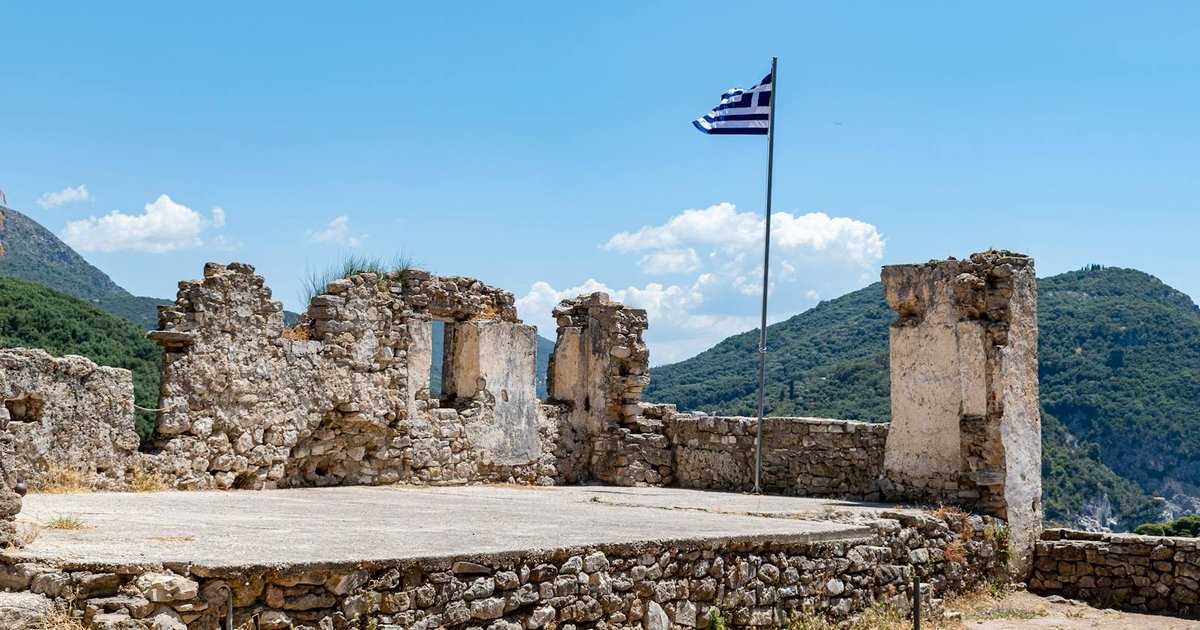
The two peaks jutting into the Ionian at the eastern end of the Spianada were fortified during the Byzantine era as a refuge against Saracen raids. Everything you see today is Venetian, built over those Byzantine foundations. Climb the lighthouse tower for the best panoramic view of the Old Town and the mainland coast.
6 min walk from Oikia 4Venice: The Long Golden Age (1386 – 1797)
For 411 years Venice ruled Corfu — longer than the United States has existed. Everything that makes the Old Town feel Italian rather than Greek was built, paved or planted in this period.
The Kantounia
The narrow Venetian alleys — kantounia — between the Liston and the New Fortress are exactly what you'd see in a minor Italian port from the same period. Tall shuttered buildings, washing lines across the streets, courtyards tucked behind heavy wooden doors. Our apartment sits within this street pattern.
Starts at our front doorThe New Fortress
Venice built the "new" fortress in the 16th century to defend against Ottoman sieges — the Old Town was sacked from the landward side in 1537 and the Venetians learned their lesson. The fortress held every subsequent siege. Free to enter, excellent views.
8 min walkOther Venetian legacies — four million olive trees (Venice paid a gold coin for every hundred planted), thousands of Italian words woven into Corfiot Greek, Catholic churches alongside Orthodox ones, the Libro d'Oro system that ranked Corfiot noble families.
Napoleon and the French (1797 – 1814)
The Liston Arcade
The elegant arcaded street along the western side of the Spianada, modelled on Paris's Rue de Rivoli. Construction began under the first French occupation (1797–1799). Today it's lined with cafés where locals read the newspaper and tourists drink spritzes. Any meal under the Liston is a meal under a Napoleonic project.
4 min walk from Oikia 4The Spianada
The grand open esplanade at the heart of the Old Town. Originally cleared by Venice as a defensive buffer against siege artillery, then laid out as a public park under the French. Cricket is played here at weekends during season — Corfu is the only place in Greece where this is true.
Edge at 4 min walkThe British Protectorate (1815 – 1864)
After Napoleon's defeat, the Congress of Vienna placed the Ionian Islands under British protection for nearly fifty years. The British legacy is surprisingly visible — and not just cricket.
Palace of St Michael & St George
Grand neoclassical building at the north end of the Spianada, built 1819–1824 as the Lord High Commissioner's residence. Today it houses the Museum of Asian Art — bizarrely, one of the finest Asian art collections in southern Europe, inherited from a wealthy Corfiot diplomat.
7 min walkMon Repos Palace
A 15-minute walk or €6 taxi to Mon Repos on the Kanoni peninsula — built 1828 as the British Commissioner's summer retreat, later the Greek royal family's residence, and the 1921 birthplace of Prince Philip, Duke of Edinburgh. Free park, small entry fee for the palace museum.
25 min walk / 10 min by busCricket, ginger beer (tsitsibira) and Corfu's famous brass marching bands all trace to the British period. The aqueduct that still partially supplies Corfu Town was Sir Frederick Adam's 1830s project.
Union with Greece (1864)
After decades of political agitation by Corfiot intellectuals, the Treaty of London ceded the islands to Greece on 21 May 1864. Still a public holiday. The British departed, leaving behind the administrative machinery, the road network and the palace. The streets stayed the same.
The 20th Century
Italian was still the language of the Corfiot upper classes into the 1920s. During WWII, Italian then German occupation caused lasting damage — a 1943 raid destroyed parts of the Old Town, and the island's Jewish community, continuous since Venetian times, was almost entirely deported to Auschwitz. A memorial on Solomou Street commemorates them; it's a two-minute walk from our apartment.
UNESCO Recognition (2007)
The Old Town was inscribed as a World Heritage Site in 2007 for the unique Venetian-French-British ensemble. The citation is specifically about the layering — no single layer is unique; it's the combination, preserved on this scale, that is.
Town Tip
Walk the Old Town once early — 7am, before cafés open, while the kantounia still smell of yesterday's cooking and the light is soft. That's when the Venetian character is most legible. Then do it again properly in the afternoon with coffee stops and shop browsing.
A Suggested Walking History Route
From our door, a four-hour walk that takes in every historical layer:
Start: Oikia 4 → Spianada (4 min) → Liston cafés (coffee) → Palace of St Michael & St George → Old Fortress (lunch at the fortress café) → back through Spianada → into the Kantounia → Church of Saint Spyridon → Archaeological Museum for the Gorgon Pediment → return to apartment.
Add Mon Repos as a half-day extension.
Getting Around
The Old Town is walkable end to end. Mon Repos is manageable on foot, or a €6–8 taxi. Achillion Palace (further south) needs a taxi or rental car.
★ Rent a Car with Herbie
If you want to extend your history trip to Achillion or Angelokastro, Herbie delivers a small car to our apartment and collects it when you're done. Easy Old Town parking at the New Fortress lot.
Book a carStay in the Old Town
Oikia 4 is our boutique apartment inside the UNESCO heart — four minutes from the Liston, eight minutes from the Old Port, everything else on foot. Our welcome book has a full walking-history route marked.
Read Next
For the Mon Repos deep-dive — the British commissioner's house, Greek royal retreat and Prince Philip's birthplace — see our Mon Repos guide. Or explore the full Oikia 4 blog for more Corfu Town guides.